
Cordele Warrant Checks
Cordele publishes no name-searchable warrant list for the public. The best Cordele warrant check for a known municipal case is a direct call to the city court. Have the citation number, case number, court date, and the name exactly as printed. Keep birth dates and other sensitive details out of any public message.
- Read the document for Cordele Police or Municipal Court.
- Call Municipal Court for a late citation or city warrant question.
- Ask whether the file shows payment due, a court setting, FTA, or an issued warrant.
- For a general arrest concern, call Crisp Sheriff and ask how it handles self-status checks.
- Keep the clerk’s office, case number, date, and next step in a private note.
Walk into a Cordele courtroom with a valid warrant on file, and you may be taken into custody on the spot. Call first to ask whether the court prefers phone contact or a lawyer's reach.
Cordele Is Crisp County's Court Hub
Cordele counted 10,220 residents in the 2020 Census, making it the population center of Crisp County. City police, Municipal Court, and the county courthouse all cluster there. That closeness can mislead. Each office keeps a different kind of record.
A Cordele address alone never makes a case municipal; the agency that issued the order and its court set the route.
Policing and Courts in Cordele
Cordele Police sits at 501 North 7th Street, Cordele, GA 31015, reachable at 229-276-2921. For Municipal Court, the deputy clerk takes 229-276-2916 and the chief clerk 229-276-2908. These are city phone lines, not countywide search portals.
Cordele Police
Police contact and agency-record routing.
229-276-2921
Cordele Municipal Court
City citation, appearance, FTA, payment, and warrant status.
229-276-2916
The court explains its orders. Police can route police records and agency questions.
Cordele Records Use Open Records Routes
Under Georgia Open Records, the Cordele Police FAQ lets you request police reports by email, fax, or in person. A request only reaches records that already exist, and some may come back redacted. For a quick answer on your own city warrant, a call to the court beats a records request. The Cordele Police FAQ lays out the records and citation routes.
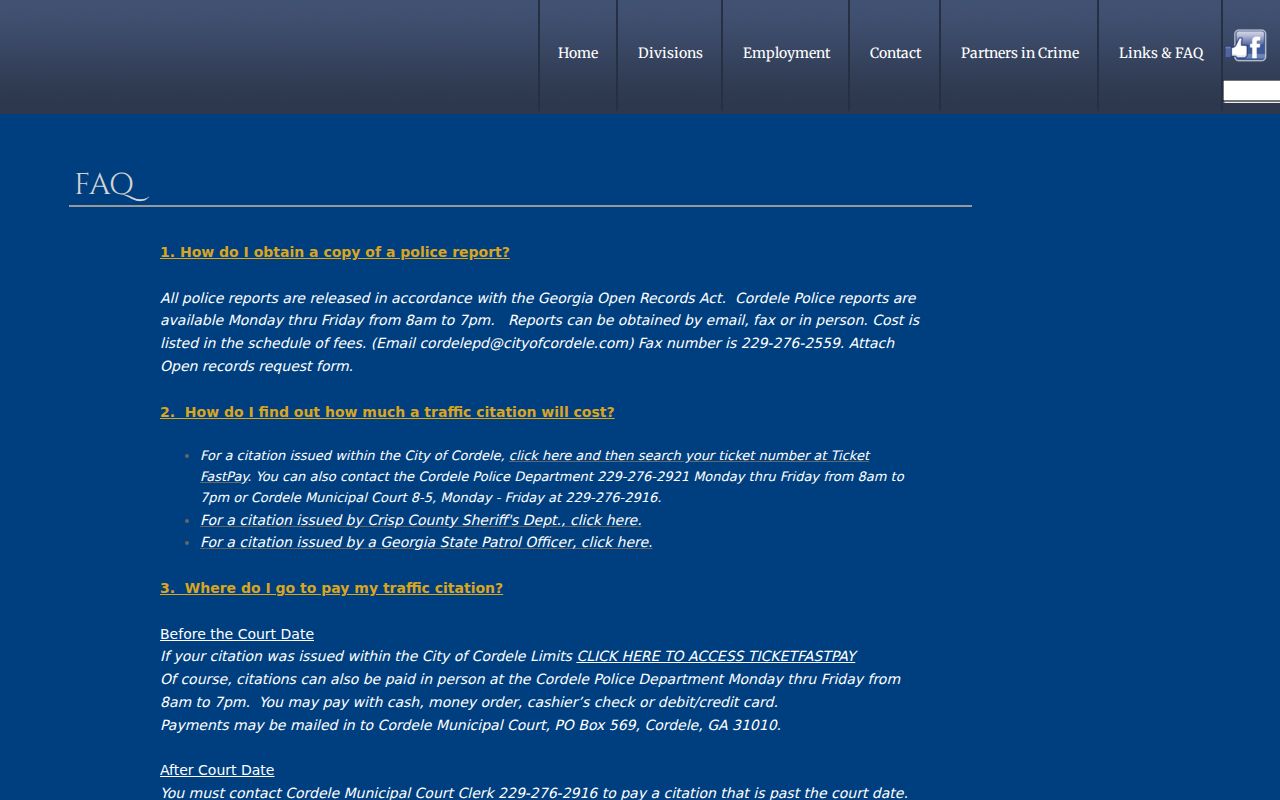
The captured material supports a phone-first court check after a missed city date.
Warrants in Cordele: The Main Types
Not every Cordele warrant starts in Municipal Court. The label on the order and the court named there tell you which office can explain it.
| Record type | How it arises | Starting route |
|---|---|---|
| Municipal bench warrant | City judge acts in a missed or unresolved case | Cordele Municipal Court |
| Traffic-related warrant | City citation moves beyond ordinary payment | Cordele Municipal Court |
| Arrest warrant | A judge finds legal grounds for arrest | Crisp Sheriff for general status |
| Search warrant | A judge authorizes a place or item search | Issuing court or agency record |
It is a court order supported by the process used for that case.
Cordele Changes the Route After Court
Cordele draws a hard line at the court date. Before it, a ticket can go through Ticket FastPay, the police department, or the mail. After that date, online payment closes and Municipal Court is the office to call. Repeated tries at the portal will not resolve a failure-to-appear or warrant question.
After the date: Call 229-276-2916 and ask whether the Cordele case needs payment, a new appearance, bond, or another court step.
Ask the Cordele clerk to confirm whether a warrant was issued and what proof will show its recall.
Cordele Warrant Records: What They Show
A Cordele warrant record may live in three places at once. The citation, the court docket, and the warrant status held by the court or serving agency each hold a piece. Those details let the clerk pull one case fast.
| Case or citation | A key such as CORDELE-CITATION. |
|---|---|
| Issuing body | Cordele Police, code officer, or another named agency. |
| Municipal charge | Traffic or local ordinance allegation. |
| Court date | The required setting and possible FTA point. |
| Order status | Active, served, recalled, or another court state. |
| Next action | Payment, appearance, bond, or clerk instruction. |
Rely on the number printed on the actual Cordele paper, since a vendor balance is not a full warrant record.
Cordele Code Compliance Serves City Warrants
The Cordele Code Compliance page says officers serve city warrants and Municipal Court summonses. This local detail shows why a Cordele warrant may involve a city officer even though the court issued it.
The city page documents the service role.

The city page documents who serves municipal orders. It does not turn an agency page into a warrant list.
Cordele Warrants and Crisp County
Cordele Municipal Court stays in charge of its own city cases. For a general arrest-warrant concern, the Crisp County Sheriff is the first public stop, and the county courts keep separate records. Georgia's justice information system serves law enforcement only, with no public statewide name search. The full Crisp County warrant records overview maps those county courts and the sheriff. That wider route matters only when the paper names no Cordele court, or the city clerk says another agency owns the record. Cordele Police and the sheriff can both touch one case over its life. Neither can recall an order issued by the other's court, though; the issuing judge or clerk alone controls court status.
Cordele Police Contact Is Not a Search
The Cordele Police contact page offers a public form and a direct phone number. It can steer a question to the right unit. It is not a Cordele warrant database, so keep the message short: ask which office handles the matter. Never post a Social Security number, full birth date, or family details there. The official Cordele Police contact page shows the city entry point.
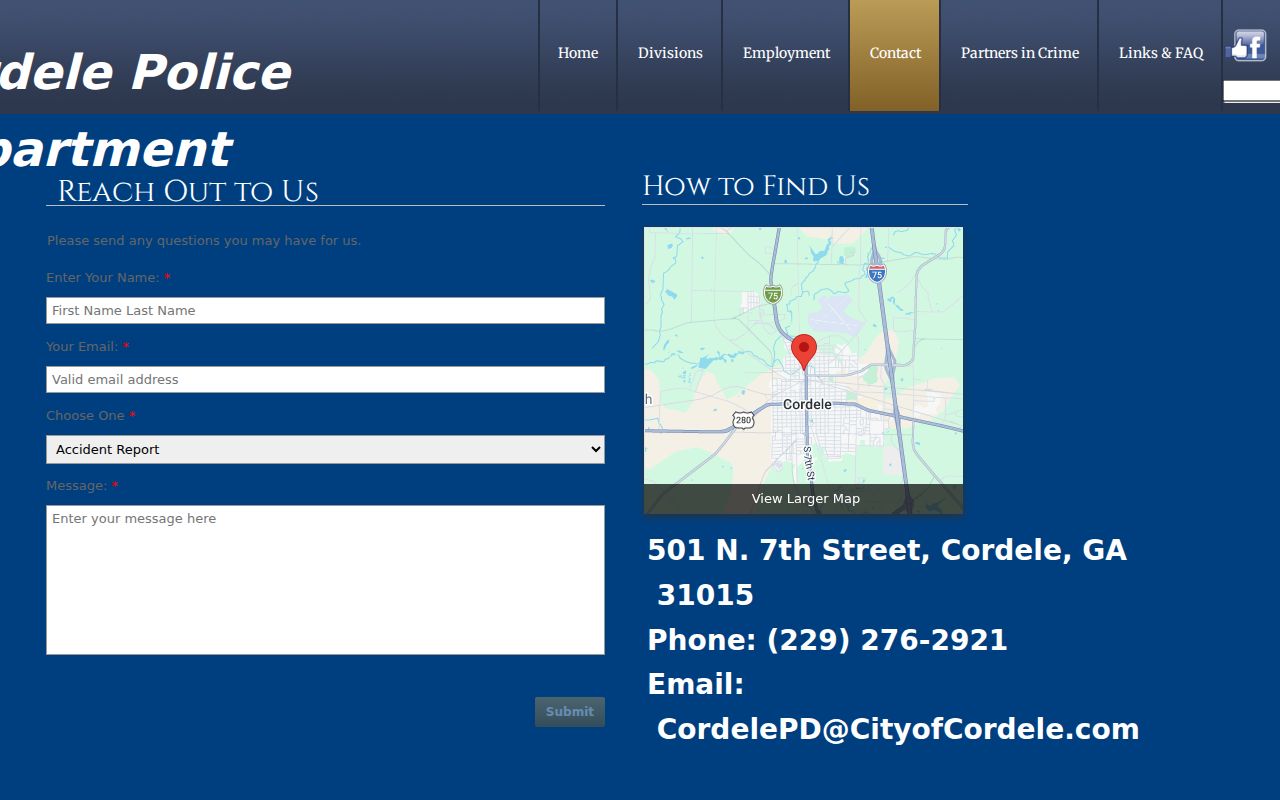
Treat that contact block as a way to find the right unit. It cannot prove a Cordele warrant exists or does not.
Accessing Cordele Warrant Records
Georgia Open Records law opens the door to existing public agency records, with limits for protected data, active matters, and other exemptions. Court records may also follow judicial access rules. A request can seek a known report or a record tied to one case. It cannot make Cordele build a warrant list the city does not keep.
Best request: Name the Cordele agency, existing record, approximate date, and preferred format, then ask for a fee estimate or exemption basis.
Juvenile and sealed records face tighter limits in Cordele and everywhere else. Keep what you receive for the court task that prompted the request.
Confirming a Cordele Warrant Recall
Once the Cordele court lays out a fix, capture the details. Save the receipt, the case number, and any order. Ask when the record will show the recall, and whether a release goes to police, the sheriff, or DDS. Each of those systems updates on its own schedule.
- Complete only the action approved by Cordele Municipal Court.
- Request written proof or a receipt tied to the case.
- Confirm that the warrant entry changed, not just the balance.
- Check any separate DDS status when the case involved FTA.
That last status check closes the gap between paying a city ticket and clearing a Cordele warrant. The follow-up date passed? Call the clerk with your ticket number. Ask whether payment stopped over timing or because the judge must act. A rejected payment or a blank result settles nothing about a Cordele warrant. An arrest warrant with no city number starts with Crisp Sheriff instead. If they refer you onward, write down the agency and the number. That record lets Cordele staff pull up the same matter. After a hearing or payment, ask for the exact status words. Paid, disposed, recalled, and released can point different directions. If an FTA report went to DDS, confirm the court release first, then check DDS second.
Cordele Citation Timing Matters
A new Cordele ticket won't appear instantly. The real deadline is the court date printed on the citation. Before that date, the official FAQ lists three options: Ticket FastPay, payment at the police department, and mail to Municipal Court. After it, the FAQ tells you to call the clerk. That shift beats poking a payment screen. So pick up the phone. Ask whether the case has been filed and whether the court still accepts payment. If a judge must act, ask how a new appearance gets set and whether counsel may contact the court. A late balance, a failed transaction, or a portal message says nothing about a Cordele warrant. Those are payment states. Warrant status is a judicial record the Cordele court keeps.
Cordele Records Stay in Separate Offices
In Cordele, police reports, dockets, warrant status, jail custody, and DDS records stay in separate hands. Cordele Police routes incident and agency-record requests. Municipal Court answers for its docket and orders. Crisp Sheriff covers the broader warrant and service route. VINE will alert you to custody changes, but it does not say whether a person has an unserved warrant. Use one case reference at every stop. Jot down the office, phone, date, and what staff told you. If two systems disagree after court action, ask the issuing Cordele clerk when the release went out. Then have the receiving agency check that same record. That steady method beats treating one screen as Cordele's whole warrant system.
Safe Cordele Self-Status Questions
Open with something plain: "I'm checking my own status in a Cordele matter and have my citation or case number." Then ask which unit confirms the court. Ask whether showing up in person is wise. Georgia's official warrant guidance warns that an in-person check can end in immediate custody when a valid warrant exists. When arrest is the worry, a defense lawyer can call the court or the sheriff and lay out your options. Don't have a friend approach law enforcement for someone else. That step takes clear consent. Never try to serve a warrant yourself. For an immediate threat, use 911. Routine Cordele warrant questions belong on the nonemergency line or the court routes described above.